
Last Updated: July 3, 2026
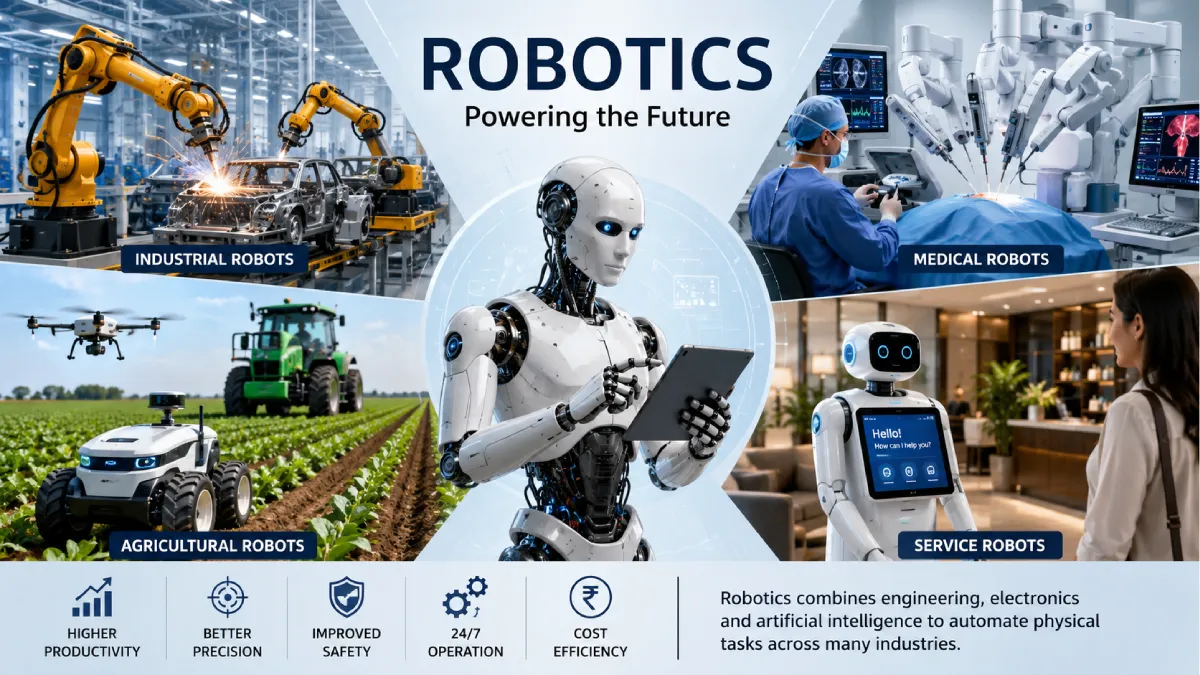
Robotics is becoming the most advanced sector. They make their presence felt everywhere, whether they are used for warehouse management or as robotic hands, whether it’s about autonomous vehicles or for operating a robot in surgery. The evolution of artificial intelligence in robotics has made it quite advanced and approachable to researchers and business entrepreneurs in India as well as the younger students of technology. It would help a business, an institution or even an individual know more about robot and intelligent machinery.
Table of Contents
Definition
It is a branch of engineering, and artificial intelligence and machine learning systems work together to make physical robots. They work under human commands. It does the job that’s not convenient to human either repetitive or dangerous or the most sensitive ones in the fastest possible and uniform way.
What Is Robotics?
Robotics is the field where you design, build, program and maintain robot that interact with the physical world.
Unlike most machines that only carry out programmed tasks, several new robots are able:
- Sense their environment
- Process information
- Make decisions
- Learn from data
- Perform tasks with minimal human intervention
The use of AI opened up enormous opportunities for robotics in the last few decades.
How Does Robotics Work?
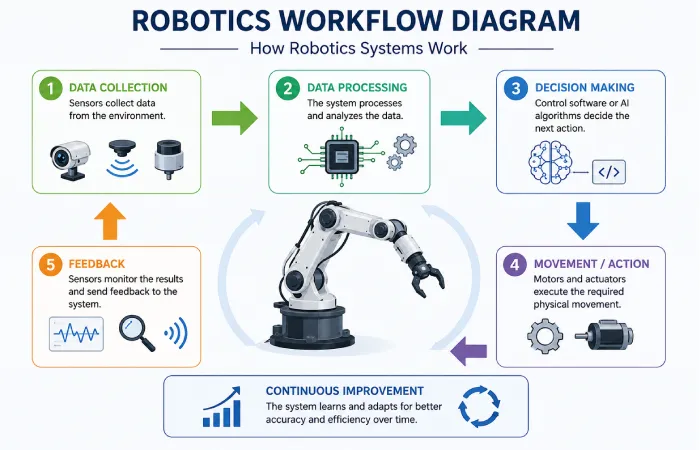
Most robots have a basic structured procedure that they follow to perform the task.
Workflow: How Robotics Systems Operate
Input → Sensors → Processing Unit → AI/Control Software → Motors & Actuators → Physical Action → Feedback → Continuous Improvement
Step 1: Data Collection
Sensors fold information from the setting, including:
- Distance
- Temperature
- Pressure
- Images
- Motion
- Sound
Step 2: Data Processing
The onboard processor takes counts of sensor inputs and manage the output/action accordingly.
Step 3: Decision Making
The control software or the AI algorithms are determining action by rules or machine learning algorithm used.
Step 4: Movement
Motors & actuators execute the required physical movement.
Step 5: Feedback
Sensors monitor results and allow the robot to adjust its actions when necessary.
5 types of robots
Robotics engineers are the ones who create and build up robots so that they can be used for various jobs. Investigate 5 various types of robotics and their design.
- Pre-programmed:These robots have a pre-programmed design. They function to perform specific tasks, and they only execute the functions within their programming, with no deviation. Examples of pre-programmed robots include a mechanical arm with a single task on an assembly line and a robot that performs a specific medical procedure.
- Teleoperated: These robots often operate in conditions that humans cannot or in those that might pose safety risks to people. They work through human-directed remote control. Some examples comprise robots that perform underwater tasks, such as repairing pipelines or submarines, and robots that hunt for and rescue humans following a tragedy like an earthquake.
- Autonomous: These robots operate self-sufficiently without human management. Autonomous robots perceive the environment through built-in sensors and adapt accordingly. Examples of robots that work independently include delivery robots and devices for vacuuming floors.
- Augmenting:Augment or replace humans, ‘Augmenting robots are powered by sensors that can be triggered either by a human’s brain or a human other bodily part such as muscles. Prosthetic limbs, which allow humans with injury or disease to regain motor functions, and exoskeletons fall into this category of augmenting robots.
- Humanoid:Humanoid robots that resemble humans either in physical look or in action. Human robots are useful to people in personal assistance, education, entertaining, manufacturing, study, & search and rescue. Examples of hominid robots are Atlas by Boston Dynamics & Sophia by Hanson Robotics.
Main Components of a Robot
Every robot contains several important components working together.
| Component | Purpose |
| Sensors | Detect surroundings |
| Controller | Processes information |
| Actuators | Produce movement |
| Motors | Drive mechanical parts |
| Power Supply | Provides energy |
| End Effectors | Perform specific tasks like gripping or welding |
| Software | Controls behaviour and automation |
Types of Robotics
Industrial Robots
Used in manufacturing for:
- Welding
- Assembly
- Packaging
- Painting
- Material handling
Service Robots
Designed to assist people in:
- Hotels
- Hospitals
- Retail stores
- Airports
- Offices
Medical Robots
Support healthcare professionals by assisting with:
- Robotic surgery
- Rehabilitation
- Pharmacy automation
- Laboratory analysis
Agricultural Robots
Help farmers through:
- Precision spraying
- Crop monitoring
- Fruit harvesting
- Soil analysis
- Autonomous tractors
Educational Robots
Widely used in schools and universities to teach:
- Coding
- Electronics
- Engineering
- Artificial Intelligence
Military Robots
Used for:
- Surveillance
- Bomb disposal
- Reconnaissance
- Disaster response
Domestic Robots
Examples include:
- Robot vacuum cleaners
- Lawn mowing robots
- Window cleaning robots
- Personal assistant robots
Comparison Table: Different Types of Robotics
| Type | Main Use | Human Supervision | Typical Environment |
| Industrial | Manufacturing | Low | Factories |
| Medical | Healthcare | High | Hospitals |
| Agricultural | Farming | Medium | Farms |
| Service | Customer assistance | Medium | Public spaces |
| Educational | Learning | High | Schools |
| Domestic | Home automation | Low | Homes |
Applications of Robotics
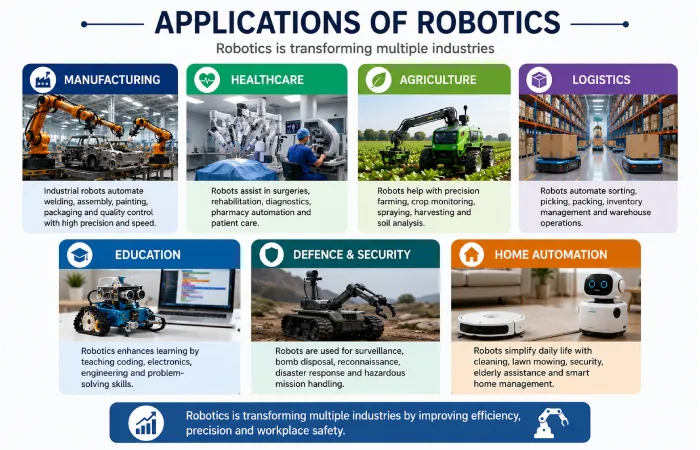
Robotics is now present in nearly every major industry.
Manufacturing
Robots assemble products with remarkable consistency while reducing production errors.
Healthcare
Hospitals use robotic systems for:
- Surgery
- Diagnostics
- Patient monitoring
- Medicine dispensing
Agriculture
Farm automation helps improve productivity while reducing manual labour.
Logistics
Warehouses use robots for:
- Sorting parcels
- Picking inventory
- Packaging
- Inventory tracking
Construction
Robotic machines assist with:
- Bricklaying
- Site inspections
- 3D printing structures
Education
Students use robotics kits to develop practical STEM skills.
Defence
Robotic technologies improve safety by performing hazardous operations remotely.
Benefits of Robotics
Some of the major advantages include:
- Higher productivity
- Better precision
- Reduced human error
- Improved workplace safety
- Faster manufacturing
- Consistent quality
- 24-hour operation
- Lower long-term operational costs
Limitations of Robotics
Despite significant progress, robotics also has limitations.
These include:
- High initial investment
- Maintenance requirements
- Complex programming
- Limited adaptability in unpredictable environments
- Dependence on electricity and software
- Cybersecurity concerns in connected systems
Understanding these limitations helps organisations set realistic expectations when adopting robotic solutions.
Robotics and Artificial Intelligence
Although often mentioned together, robotics and AI are not identical.
| Robotics | Artificial Intelligence |
| Focuses on physical machines | Focuses on intelligent software |
| Performs physical tasks | Performs decision-making tasks |
| Uses sensors and motors | Uses algorithms and data |
| Can operate without AI | Can exist without robots |
Today‘s intelligent robotic systems are progressively integrating both techniques in order to enhance their autonomous capabilities and reaction.
Robotics in India
India has experienced steady development in robotics adoption across businesses.
Key sectors include:
- Automobile manufacturing
- Pharmaceutical production
- Healthcare
- Agriculture
- Warehousing
- Electronics manufacturing
- Educational institutions
- Research laboratories
Another reason for the booming robot research and development is that the government sponsored policies, such as digitalization and advanced manufacturing.
Future of Robotics
The future of robotics is expected to include:
- Smarter collaborative robots (cobots)
- AI-powered autonomous machines
- Advanced healthcare robotics
- Agricultural automation
- Smart city infrastructure
- Space exploration robots
- Disaster rescue systems
- Household assistant robots
With the advancement of computing technology and artificial intelligence, robots will be able to better operate in real-world environment.
Who uses robotics?
Robotics can be found in almost any industry from food and beverage to general manufacturing and transportation. Potential users could be:
- Aircraft inspectors
- Astronauts
- Automobile manufacturers
- Disaster responders
- Factory owners
- Financial consultants
- Pharmacists
- Pipeline developers
- Restaurant owners
- Retailers
- Surgeons
Expectations: What Robotics Can & Cannot Do
It is significant to maintain realistic prospects about robotics.
What Robotics Can Do
- Perform repetitive tasks accurately
- Operate continuously with minimal fatigue
- Improve manufacturing efficiency
- Assist professionals in specialised fields
- Handle hazardous environments safely
What Robotics Cannot Yet Fully Do
- Replace all forms of human creativity
- Understand complex emotions like humans
- Adapt flawlessly to every unpredictable situation
- Eliminate the need for skilled human mistake
Most of the industries are using robot to support human workers to do their job, rather than totally replace their worker.
Is Robotics a Good Career?
Robotics could be suitable for anyone interested in engineering, programming, electronics and artificial intelligence.
Popular career paths include:
- Robotics Engineer
- Automation Engineer
- AI Engineer
- Mechanical Design Engineer
- Embedded Systems Developer
- Robotics Researcher
- Industrial Automation Specialist
- Robotics Technician
If you are studying engineering, computer science, or electronics, then you will find that work in robotics is very rewarding and there is an ever-increasing demand.
Tips for Learning Robotics
If you are beginning your robotics journey:
- Learn the basic programming (such as Python or C++).
- Understand the electronics & circuits.
- Study mechanics and control systems.
- Build simple robotic projects.
- Explore AI and machine learning concepts.
- Practise with the robotics development kits.
- Contribute in competitions & open-source projects.
FAQ’s
What is Robotics?
Robotics: is a branch or division of engineering and technology that is concerned with the design, construction, application, and operation of robots.
Where is Robotics used?
Robotics are mainly be used for manufacturing, healthcare, logistics, agriculture, education, defence, construction and housework applications.
Does Robotics use Artificial Intelligence?
While not all robots or robotic systems incorporate AI, many more advanced robotic systems, in particular, do.
Is Robotics a good career in India?
Yes. As robotics is becoming extremely important in manufacturing, automation, healthcare, research and technology industries so the demand of professionals in this field will remain high.
Can beginners learn Robotics?
Yes. A complete novice can also begin with the programming, electronics and basic engineering and develop to go the highest levels in robotics.
Conclusion
Robotics is still revolutionising many businesses, transporting together technologies of manufacturing, automation & intelligent software to meet many everyday tests. Its many applications improve efficiency and human safety, with robotics finding use in industrial production, areas of medicine, food growing and education. As robots become more adept, the most effective use will continue to be in conjunction with highly skilled technicians. The knowledge gained now can be applied to many roles in the next few decades.
