
Last Updated: July 2, 2026
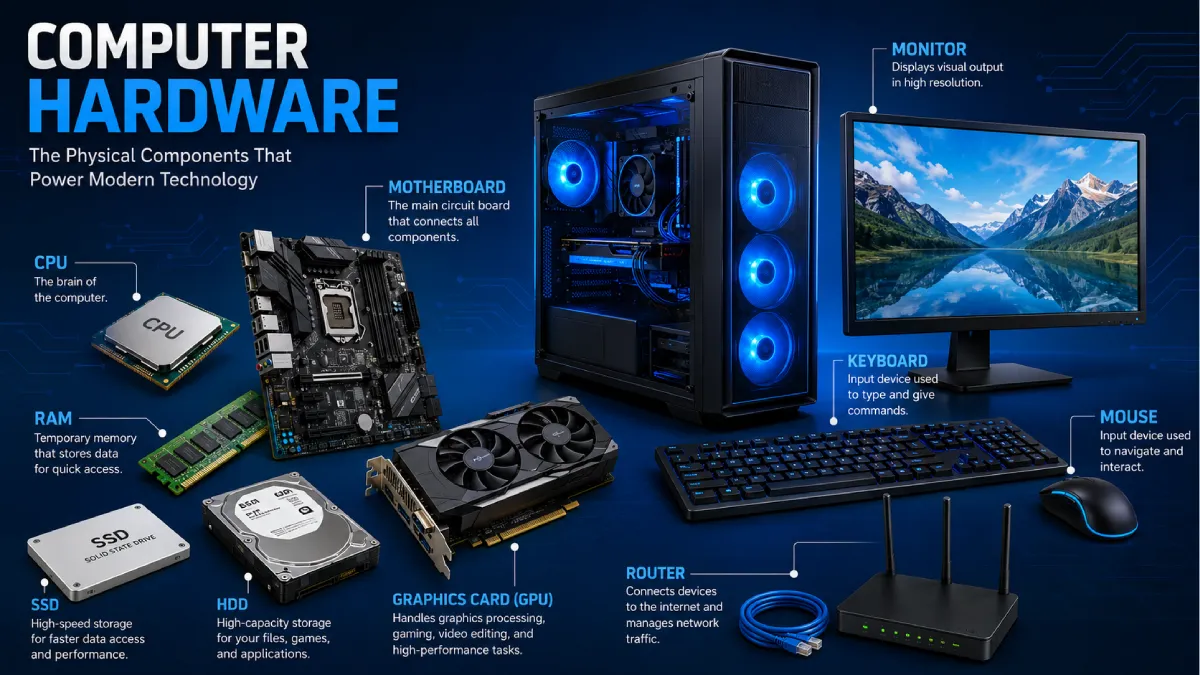
Computer Hardware is the physical basis for all computer and digital devices, whether it be a desktop computer, laptop, smartphone, gaming console, server or any other device which runs in your home, school or workplace. In simple terms, hardware is the part that physically comprises your computer and other related digital technologies. It cannot do without software, that’s why, it plays a vital role in it.
The hardware permits a user to play a video, use a mouse, or a keyboard or use their screen, a laptop, for computing functions efficiently.
The current PC hardware is quicker, littler, extra fuel-effective and potent than the past. Here in this blog, you will learn all about computer hardware; what is a hardware, its kinds, parts, pros and cons, maintenance guide and future.
Table of Contents
What is Hardware?
Hardware refers to all the physical parts of a computer or electronic device that can be seen and touched. These components work together with software to perform various computing tasks.
Examples include:
- CPU (Processor)
- Motherboard
- RAM
- Hard Disk
- SSD
- Keyboard
- Mouse
- Monitor
- Printer
- Graphics Card
- Power Supply
Simply put:
Hardware = Physical Components
Software = Programs and Applications
Both are required for a computer to function properly.
Why is Hardware Important?
Hardware provides the physical infrastructure needed for computing.
It is responsible for:
- Processing information
- Storing data
- Running applications
- Displaying graphics
- Connecting to the internet
- Managing input and output
- Supporting business operations
- Enabling communication
Without hardware, digital systems would not exist.
Main Types of Hardware
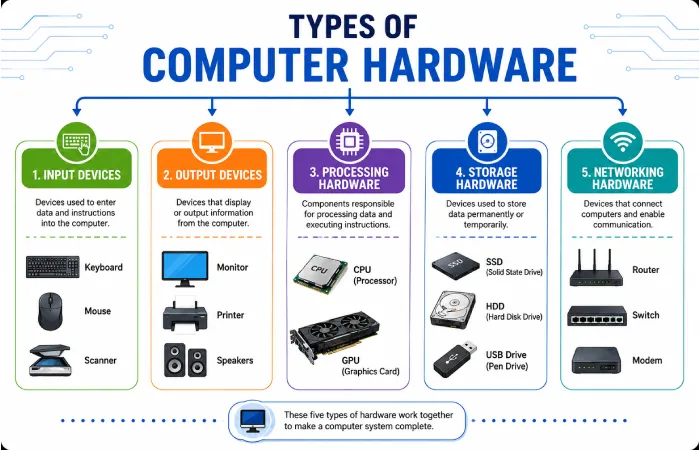
Computer hardware can be divided into several categories.
1. Input Hardware
Input devices allow users to enter information into a computer.
Examples:
- Keyboard
- Mouse
- Scanner
- Webcam
- Microphone
- Touchscreen
- Barcode Scanner
- Graphics Tablet
Functions:
- Enter text
- Control cursor
- Capture images
- Record audio
- Scan documents
2. Output Hardware
Output devices display processed information.
Examples:
- Monitor
- Printer
- Speakers
- Projector
- Plotter
Functions:
- Display images
- Print documents
- Produce sound
- Show presentations
3. Processing Hardware
Processing hardware performs calculations.
Examples include:
- CPU
- GPU
- Chipsets
These components execute millions of instructions every second.
4. Storage Hardware
Storage devices save data permanently or temporarily.
Examples:
Primary Storage
- RAM
- Cache Memory
Secondary Storage
- SSD
- HDD
- USB Flash Drive
- Memory Card
- External Hard Drive
5. Networking Hardware
Networking hardware enables communication between devices.
Examples:
- Router
- Switch
- Hub
- Modem
- Firewall Appliance
- Wireless Access Point
- Network Interface Card (NIC)
Internal Hardware Components
Central Processing Unit (CPU)
The CPU is the brain of the computer.
Responsibilities:
- Execute instructions
- Perform calculations
- Control system operations
- Coordinate hardware activities
Motherboard
The motherboard connects every hardware component together.
It contains:
- CPU socket
- RAM slots
- Expansion slots
- Storage connectors
- Power connectors
RAM (Random Access Memory)
RAM temporarily stores data while programs are running.
Benefits:
- Faster multitasking
- Improved application performance
- Reduced loading time
Graphics Card (GPU)
The graphics processing unit renders:
- Images
- Videos
- Games
- 3D graphics
- AI workloads
Power Supply Unit (PSU)
Converts AC electricity into DC power for computer components.
Cooling System
Keeps components at safe operating temperatures.
Includes:
- Fans
- Heat sinks
- Liquid cooling
External Hardware Devices
External hardware connects to the computer externally.
Examples include:
- Keyboard
- Mouse
- Printer
- Scanner
- Webcam
- Speakers
- External SSD
- USB Drive
- External Monitor
Examples of Computer Hardware
Some common hardware devices include:
- Desktop Computer
- Laptop
- Smartphone
- Tablet
- Monitor
- Keyboard
- Mouse
- SSD
- Hard Disk
- CPU
- Motherboard
- GPU
- Printer
- Scanner
- Router
- Webcam
- Speakers
- UPS
Hardware vs Software
| Hardware | Software |
| Physical components | Programs and applications |
| Can be touched | Cannot be touched |
| Manufactured | Developed through coding |
| Can wear out | Can be updated |
| Requires software | Requires hardware |
How Hardware Works
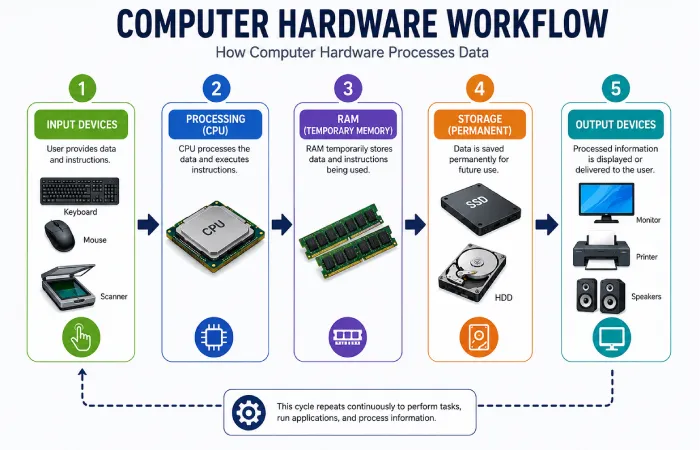
The hardware workflow follows these steps:
Step 1
User provides input using:
- Keyboard
- Mouse
- Scanner
↓
Step 2
CPU processes instructions.
↓
Step 3
RAM temporarily stores working data.
↓
Step 4
Storage devices save files permanently.
↓
Step 5
Output devices display results.
Advantages of Hardware
Some major benefits include:
High Performance
Modern hardware processes billions of instructions quickly.
Reliability
Quality hardware lasts for years with proper maintenance.
Better Productivity
Faster systems improve work efficiency.
Gaming Performance
Dedicated GPUs enable high-end gaming.
Multimedia Support
Supports video editing, streaming, animation, and graphic design.
Business Operations
Essential for offices, hospitals, schools, and industries.
Disadvantages of Hardware
Despite many benefits, hardware has limitations.
- Expensive upgrades
- Physical damage
- Component failure
- Heat generation
- Power consumption
- Requires maintenance
- Technology becomes outdated
Common Hardware Problems
Users often experience:
Slow Performance
Possible causes:
- Low RAM
- Old HDD
- Background applications
Overheating
Reasons:
- Dust buildup
- Faulty fans
- Poor ventilation
Hard Drive Failure
Symptoms:
- Missing files
- Strange noises
- Slow loading
Blue Screen Errors
May result from:
- Faulty RAM
- Driver issues
- Hardware conflicts
Power Problems
Common causes:
- Faulty PSU
- Loose cables
- Electrical fluctuations
Hardware Maintenance Tips
To extend hardware life:
- Clean dust regularly.
- Update firmware when available.
- Keep the system cool.
- Use surge protectors or UPS.
- Replace failing storage devices promptly.
- Monitor temperatures.
- Back up important data.
- Avoid physical shocks.
- Install reliable antivirus software.
- Upgrade RAM or SSD when needed.
Industries That Depend on Hardware
Hardware is essential across many sectors.
Education
- Smart classrooms
- Computer labs
- Online learning
Healthcare
- Medical imaging
- Patient monitoring
- Digital records
Banking
- ATMs
- Secure servers
- Transaction systems
Manufacturing
- Robotics
- Automation
- Industrial control systems
Retail
- POS machines
- Barcode scanners
- Inventory systems
Entertainment
- Gaming PCs
- Video production
- Streaming equipment
Future Trends in Hardware
Emerging technologies are shaping the future of hardware.
AI-Optimized Processors
Designed to accelerate artificial intelligence workloads.
Faster SSD Storage
Improved speed and reliability with newer interfaces.
Energy-Efficient Chips
Lower power consumption while maintaining high performance.
Quantum Computing Hardware
Specialized systems for solving complex computational problems.
Edge Computing Devices
Local processing reduces latency for IoT and AI applications.
Sustainable Hardware
The dealers are adopting new methods like recycling waste resources & designing parts to save on power ingesting.
How to Choose the Right Hardware
Before purchasing the hardware, consider:
- Purpose (gaming, office, editing, programming)
- Processor performance
- RAM capacity
- Storage type (SSD preferred)
- Graphics requirements
- Upgrade options
- Power efficiency
- Warranty and support
- Budget
- Brand reliability
FAQ’s
What is hardware?
Hardware are the tangible pieces of electronic hardware a user can see and feel.
What are the five main types of hardware?
Input hardware, output hardware, processing hardware, storage hardware, and networking hardware constitute the main categories.
What is the difference between hardware and software?
Hardware is physical computer equipment whereas the software consists of the set of commands and instructions that run on this hardware.
What are examples of hardware?
Examples can be CPUS, Motherboard, RAM, SSD’s, Hard Drive, Keyboards, Mouse, Monitors, Printers, Router and Graphics card.
Why is hardware important?
The functions that the computer and any digital devices do (input, output, processing, networking, storage etc.) is performed by hardware.
Can hardware work without software?
No. Hardware requires software to perform meaningful tasks, and software requires hardware to run.
How long does computer hardware last?
Your typical computer components can last anywhere between 3 – 10 years depending on how you use your machine, how you care for your machine, and how good of a machine you bought in the first place.
Which hardware upgrade improves performance the most?
For most people, an SSD upgrade plus more RAM is all that is required for increased speed.
Conclusion
The Hardware forms the core of any computing a device, referring to the physical parts essential to execute tasks, store data, and connect users with numerous software applications. Knowing the kinds of hardware, the jobs they perform, and the interactions that they share ensures that companies and individuals are making well-informed choices regarding equipment gaining and care. Because of the rapid developments occurring within the technological field, hardware components are continuing to achieve higher speeds, greater efficiency, and suitability for such demanding tasks as AI dispensation, cloud hosting, video games and data analysis. Using hardware components correctly and taking care of them will extend their useful life.
